Discussion guide · 8 weeks

The Call to Be Uncomn

What it means to hear the word of God and make intentional decisions to be set apart: useful to the Lord, ready for any good work, and walking in freedom, power and peace by abiding in Jesus.

Lesson 1 of 8

Being Set Apart

2 Timothy 2:20–26 ESV

20Now in a great house there are not only vessels of gold and silver but also of wood and clay, some for honorable use, some for dishonorable. 21Therefore, if anyone cleanses himself from what is dishonorable, he will be a vessel for honorable use, set apart as holy, useful to the master of the house, ready for every good work. 22So flee youthful passions and pursue righteousness, faith, love, and peace, along with those who call on the Lord from a pure heart. 23Have nothing to do with foolish, ignorant controversies; you know that they breed quarrels. 24And the Lord’s servant must not be quarrelsome but kind to everyone, able to teach, patiently enduring evil, 25correcting his opponents with gentleness. God may perhaps grant them repentance leading to a knowledge of the truth, 26and they may come to their senses and escape from the snare of the devil, after being captured by him to do his will.

What we’re discussing

We are called to be different in this world: to walk, love and interact with others while focusing on His Kingdom and purifying ourselves, so that we can be useful to the Master, prepared for any good work.

This concept is vital to our Christian walk. Ephesians 2:10 says that God has prepared good works for each of us to walk in. In this passage we talk about being “cleansed and set apart,” or uncommon (holy).

Questions

  1. We all want to do great things for the Lord. What are the requirements in the first two verses?
  2. What are the good works God has called you to personally? Be specific. We all know the fruit of the Spirit; be more introspective.
  3. Why do you think the distinction between honorable and dishonorable vessels is important?
  4. Who do we usually see as “dishonorable,” or of lesser value, in the church, missions or the kingdom?
  5. Verse 22 is a powerful call to action. What is it calling you to flee, and what is it calling you to pursue?
  6. In verses 23–26, why is it important to follow these practices?

    Follow-upHow often do you think we act in accordance with these characteristics?
Lesson 2 of 8

New Creation in Christ

2 Corinthians 5:13–21 ESV

13For if we are beside ourselves, it is for God; if we are in our right mind, it is for you. 14For the love of Christ controls us, because we have concluded this: that one has died for all, therefore all have died; 15and he died for all, that those who live might no longer live for themselves but for him who for their sake died and was raised. 16From now on, therefore, we regard no one according to the flesh. Even though we once regarded Christ according to the flesh, we regard him thus no longer. 17Therefore, if anyone is in Christ, he is a new creation. The old has passed away; behold, the new has come. 18All this is from God, who through Christ reconciled us to himself and gave us the ministry of reconciliation; 19that is, in Christ God was reconciling the world to himself, not counting their trespasses against them, and entrusting to us the message of reconciliation. 20Therefore, we are ambassadors for Christ, God making his appeal through us. We implore you on behalf of Christ, be reconciled to God. 21For our sake he made him to be sin who knew no sin, so that in him we might become the righteousness of God.

What we’re discussing

This passage touches on a transformational idea in Christianity: dying to yourself and living under the control of Jesus. God calls us to live for the good of others, not ourselves, through the power of Jesus. We are a new creation. The old “you” has passed away and no longer exists.

God is reconciling the world back to Himself through His children. This idea is so powerful and so central to our mission.

Questions

  1. What does it mean for the love of Christ to “control” someone? Where do you see that in your own life?
  2. Verse 15 says those who live should “no longer live for themselves.” What does living for yourself look like in an ordinary week?
  3. “The old has passed away.” What old patterns or labels do you still find yourself living by? Or what does “the old has passed away” practically mean to you?
  4. Paul says we regard no one “according to the flesh.” How might that change the way you see a coworker, neighbor or family member?
  5. “Therefore, we are ambassadors for Christ, God making his appeal through us.” If God uses us to reach the world, are we properly representing the power and authority that Jesus walked in? The love and peace that He left us?

Lesson 3 of 8

Walk by the Spirit

Galatians 5:16–25 ESV

16But I say, walk by the Spirit, and you will not gratify the desires of the flesh. 17For the desires of the flesh are against the Spirit, and the desires of the Spirit are against the flesh, for these are opposed to each other, to keep you from doing the things you want to do. 18But if you are led by the Spirit, you are not under the law. 19Now the works of the flesh are evident: sexual immorality, impurity, sensuality, 20idolatry, sorcery, enmity, strife, jealousy, fits of anger, rivalries, dissensions, divisions, 21envy, drunkenness, orgies, and things like these. I warn you, as I warned you before, that those who do such things will not inherit the kingdom of God. 22But the fruit of the Spirit is love, joy, peace, patience, kindness, goodness, faithfulness, 23gentleness, self-control; against such things there is no law. 24And those who belong to Christ Jesus have crucified the flesh with its passions and desires. 25If we live by the Spirit, let us also keep in step with the Spirit.

What we’re discussing

This is one of the most incredible concepts in Scripture. You won’t get the full effect without the Greek, because our English doesn’t carry the meaning Paul was using in this first verse.

“Walk by the Spirit, and you will not gratify the desires of the flesh.” In Greek, “will not gratify” is a double negative. Not the kind that contradicts itself: it’s a paradox. When you walk by the Spirit, it is impossible to gratify the sinful nature. I absolutely cannot do it.

Questions

  1. Where do you feel the tension of verse 17 most in your life?
  2. Paul writes “works” of the flesh but “fruit” of the Spirit. What does that difference suggest about how change happens?
  3. Which fruit of the Spirit do you see growing in someone else in this group?
  4. Which one do you most want God to grow in you right now?
  5. What does “keeping in step with the Spirit” look like on an ordinary Tuesday afternoon?

Lesson 4 of 8

Overcoming the World

1 John 5:1–5 ESV

1Everyone who believes that Jesus is the Christ has been born of God, and everyone who loves the Father loves whoever has been born of him. 2By this we know that we love the children of God, when we love God and obey his commandments. 3For this is the love of God, that we keep his commandments. And his commandments are not burdensome. 4For everyone who has been born of God overcomes the world. And this is the victory that has overcome the world—our faith. 5Who is it that overcomes the world except the one who believes that Jesus is the Son of God?

What we’re discussing

John ties together three things we tend to keep separate: believing in Jesus, loving God’s people and obeying his commands. The result isn’t a burden. It’s victory.

We don’t overcome the world by trying harder. What does it look like to continually overcome the world? Where do we integrate faith into our everyday life?

Questions

  1. John says God’s commands “are not burdensome.” Is that your experience? Why or why not?
  2. How are loving God, loving his children and obeying him connected in this passage?
  3. What does “the world” mean here? What does it try to pull you toward?
  4. Verse 4 says our faith is the victory. Where do you need to trust that instead of your own effort?
  5. Where have you already seen God give you victory over something?

Lesson 5 of 8

Abiding in the Vine

John 15:1–11 ESV

1“I am the true vine, and my Father is the vinedresser. 2Every branch in me that does not bear fruit he takes away, and every branch that does bear fruit he prunes, that it may bear more fruit. 3Already you are clean because of the word that I have spoken to you. 4Abide in me, and I in you. As the branch cannot bear fruit by itself, unless it abides in the vine, neither can you, unless you abide in me. 5I am the vine; you are the branches. Whoever abides in me and I in him, he it is that bears much fruit, for apart from me you can do nothing. 6If anyone does not abide in me he is thrown away like a branch and withers; and the branches are gathered, thrown into the fire, and burned. 7If you abide in me, and my words abide in you, ask whatever you wish, and it will be done for you. 8By this my Father is glorified, that you bear much fruit and so prove to be my disciples. 9As the Father has loved me, so have I loved you. Abide in my love. 10If you keep my commandments, you will abide in my love, just as I have kept my Father’s commandments and abide in his love. 11These things I have spoken to you, that my joy may be in you, and that your joy may be full.

What we’re discussing

Jesus is the vine and we are the branches. A branch doesn’t strain to produce fruit. It stays connected.

This week we look at what it means to abide: what it looks like to be free, and how we can live in strength and power in our everyday life.

Questions

  1. “Apart from me you can do nothing.” Where are you most tempted to try to do things apart from Him?
  2. What does abiding look like for you day to day? Which habits help you stay connected?
  3. Seasons of pruning can cut back even branches that bear fruit. Have you been through a season like that? What grew afterward?
  4. How are obedience and abiding connected in verses 9–10?
  5. Jesus wants his joy to be in us and our joy to be full. What steals your joy, and what restores it?

Lesson 6 of 8

Knowing Your Position & Authority

Ephesians 2:4–10 ESV

4But God, being rich in mercy, because of the great love with which he loved us, 5even when we were dead in our trespasses, made us alive together with Christ—by grace you have been saved— 6and raised us up with him and seated us with him in the heavenly places in Christ Jesus, 7so that in the coming ages he might show the immeasurable riches of his grace in kindness toward us in Christ Jesus. 8For by grace you have been saved through faith. And this is not your own doing; it is the gift of God, 9not a result of works, so that no one may boast. 10For we are his workmanship, created in Christ Jesus for good works, which God prepared beforehand, that we should walk in them.

Ephesians 3:14–21 ESV

14For this reason I bow my knees before the Father, 15from whom every family in heaven and on earth is named, 16that according to the riches of his glory he may grant you to be strengthened with power through his Spirit in your inner being, 17so that Christ may dwell in your hearts through faith—that you, being rooted and grounded in love, 18may have strength to comprehend with all the saints what is the breadth and length and height and depth, 19and to know the love of Christ that surpasses knowledge, that you may be filled with all the fullness of God. 20Now to him who is able to do far more abundantly than all that we ask or think, according to the power at work within us, 21to him be glory in the church and in Christ Jesus throughout all generations, forever and ever. Amen.

What we’re discussing

Two passages from the same letter speak to our position in Christ. Where does our authority come from? What power and love do we have access to? And we reflect on how great God’s love is for us.

The last two verses of the second passage are so powerful. We have access to the greatest power in the world, and yet sometimes we live powerless.

Questions

  1. Ephesians 2 says we have been raised and seated with Christ. How does knowing your position in him change how you face hard things?
  2. Why is Paul so clear that salvation is “not your own doing”? Where do you still try to earn God’s approval?
  3. “We are his workmanship, created … for good works.” What good works might God have prepared for you in this season?
  4. Paul prays for power through the Spirit “in your inner being.” Where do you need that strength right now?
  5. God is able to do “far more abundantly than all that we ask or think.” What would you ask him for if you really believed that?

Lesson 7 of 8

Living in Peace and Presence

John 14:26–28 ESV

26But the Helper, the Holy Spirit, whom the Father will send in my name, he will teach you all things and bring to your remembrance all that I have said to you. 27Peace I leave with you; my peace I give to you. Not as the world gives do I give to you. Let not your hearts be troubled, neither let them be afraid. 28You heard me say to you, ‘I am going away, and I will come to you.’ If you loved me, you would have rejoiced, because I am going to the Father, for the Father is greater than I.

Philippians 4:6–7 ESV

6Do not be anxious about anything, but in everything by prayer and supplication with thanksgiving let your requests be made known to God. 7And the peace of God, which surpasses all understanding, will guard your hearts and your minds in Christ Jesus.

What we’re discussing

Jesus promised the Holy Spirit as our Helper and left us his own peace, a peace unlike anything the world offers.

We’ve talked a lot about what it looks like to be an empowered, free, selfless follower of Jesus. What good is it if we keep it to ourselves? If we don’t carry peace with us, we will never impact people outside of Christianity. We will never have something to share. Peace and the love of Christ are the two most powerful things that can be tangibly experienced in this world.

Questions

  1. How is the peace Jesus gives different from the peace the world offers?
  2. What is making you anxious right now?
  3. Paul says to pray “with thanksgiving.” Why does gratitude matter when we’re anxious?
  4. The Spirit will “bring to your remembrance” what Jesus said. When has a word from Scripture come back to you at just the right moment?
  5. What would it look like to practice God’s presence in the busiest part of your day?

Lesson 8 of 8

Setting a Vision

John 16:33 ESV

33I have said these things to you, that in me you may have peace. In the world you will have tribulation. But take heart; I have overcome the world.”

Colossians 3:1–10 ESV

1If then you have been raised with Christ, seek the things that are above, where Christ is, seated at the right hand of God. 2Set your minds on things that are above, not on things that are on earth. 3For you have died, and your life is hidden with Christ in God. 4When Christ who is your life appears, then you also will appear with him in glory. 5Put to death therefore what is earthly in you: sexual immorality, impurity, passion, evil desire, and covetousness, which is idolatry. 6On account of these the wrath of God is coming. 7In these you too once walked, when you were living in them. 8But now you must put them all away: anger, wrath, malice, slander, and obscene talk from your mouth. 9Do not lie to one another, seeing that you have put off the old self with its practices 10and have put on the new self, which is being renewed in knowledge after the image of its creator.

What we’re discussing

Jesus is honest with us: in this world we will have trouble. But he has overcome the world. Because we have been raised with him, Paul calls us to set our minds on things above, to put off the old self and to put on the new. We close the course by casting a vision for who God is making us, and for the people he is sending us to.

Questions

  1. Jesus says “take heart” right after promising tribulation. How do you hold those two together?
  2. What does it look like to set your mind on things above without checking out of everyday life?
  3. Paul lists things to put to death and to put away. Which of them do you still have to fight?
  4. Looking back over these eight weeks, where have you seen God set you apart?
  5. What vision is God giving you for the next season, for yourself and for the people around you?

Take it to your group

Ready to go through this course with your group?

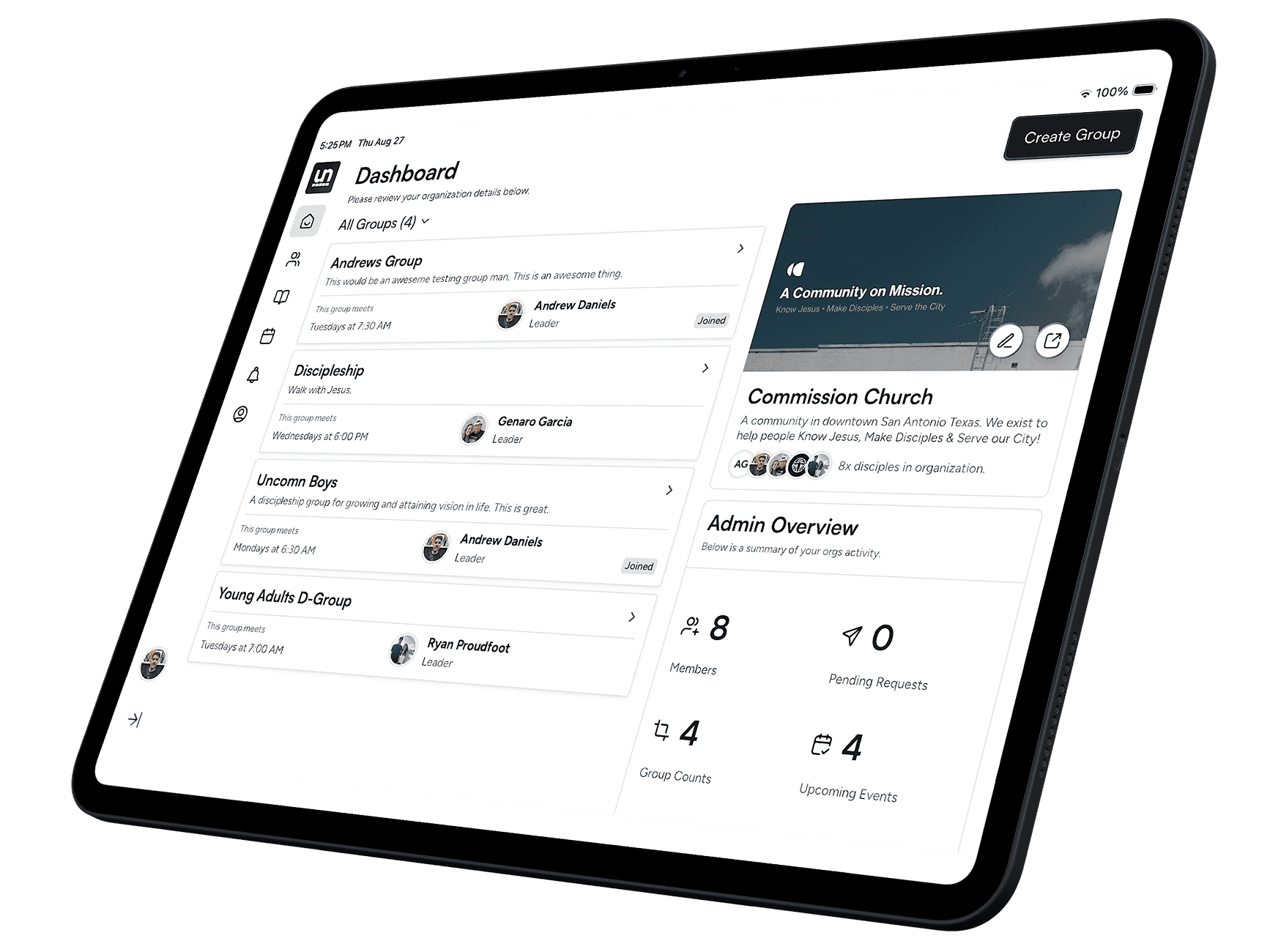
Create your group today. Uncomn schedules your meetings, sends the reminders, and lines up each week’s lesson for everyone.

Coming Soon to Play Store